

Understanding the Warning Signs Your Body Is Sending
Adrenal fatigue symptoms can leave you feeling exhausted even after a full night’s sleep, craving salt or sugar, struggling with brain fog, and unable to cope with everyday stress. While not a recognized medical diagnosis, these symptoms represent a real pattern of chronic stress-related exhaustion that affects millions of people.
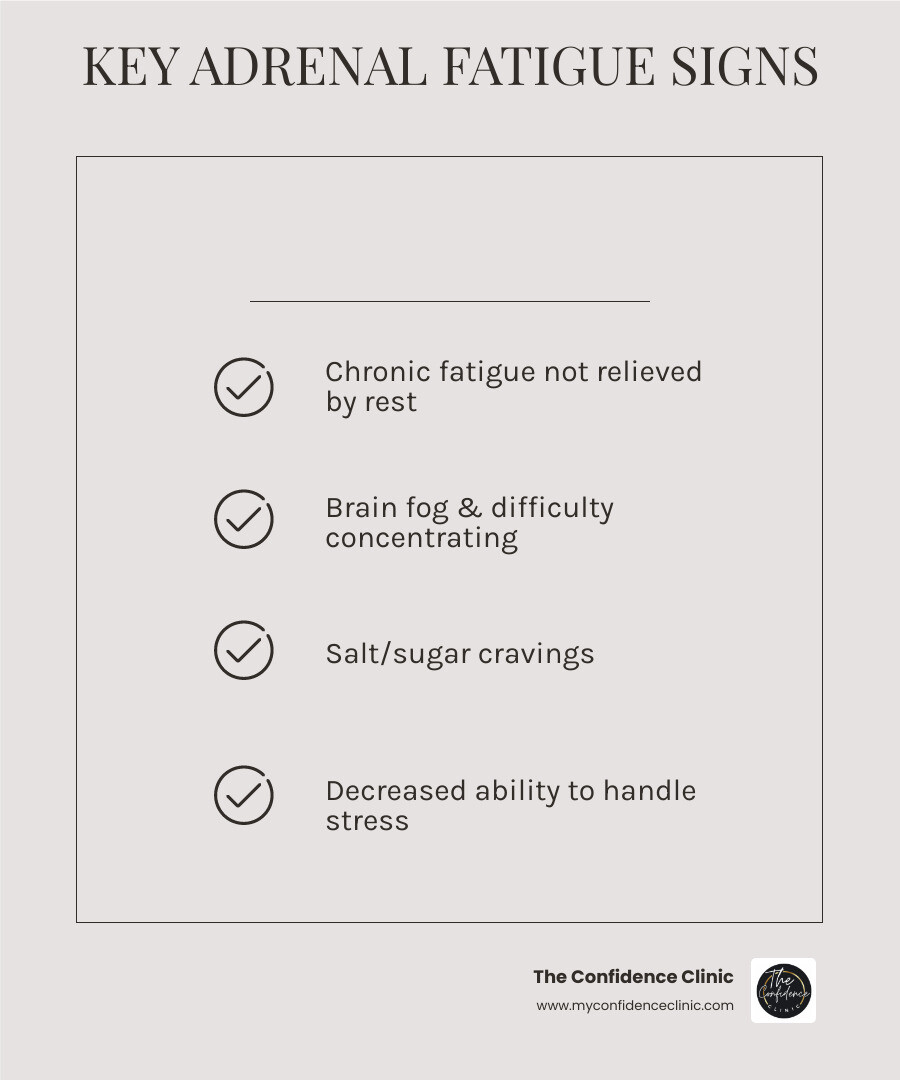
Common adrenal fatigue symptoms include:
- Chronic fatigue that isn’t relieved by rest
- Morning exhaustion and difficulty waking up
- Afternoon energy crashes (typically 3-4 PM)
- Salt and sugar cravings
- Brain fog and difficulty concentrating
- Sleep disturbances despite feeling tired
- Low blood pressure and dizziness when standing
- Unexplained weight gain (especially around the abdomen)
- Decreased ability to handle stress
- Low libido and lack of motivation
- Irritability, anxiety, or feeling overwhelmed
Are you constantly exhausted, relying on caffeine just to get through the day, and feeling like stress has taken over your life? You’re not alone. An estimated 50-70 million Americans aren’t getting enough sleep, and many more are experiencing the crushing weight of chronic stress that conventional medicine often dismisses or overlooks.
The concept of “adrenal fatigue” sits at the center of a heated medical debate. While mainstream endocrinology doesn’t recognize it as an official diagnosis, functional medicine practitioners see a clear pattern: chronic stress overwhelming the body’s stress-response system, leading to a cascade of debilitating symptoms.
This guide will help you understand what adrenal fatigue symptoms really mean, how they differ from serious adrenal disorders like Addison’s disease, and most importantly—what root causes might be driving your exhaustion. We’ll explore evidence-based approaches to diagnosis and recovery that go beyond simply managing symptoms.
I’m Dr. Mo Cale, a board-certified physician and Medical Director of Center for Confidence, where I’ve spent over a decade helping patients uncover the root causes of persistent symptoms like fatigue, hormone imbalances, and stress-related conditions that are often dismissed by conventional medicine. Through a functional medicine lens, I’ve guided hundreds of patients in understanding their adrenal fatigue symptoms and developing personalized treatment plans that address the whole person—not just isolated symptoms.
What is “Adrenal Fatigue”? A Functional Medicine Perspective
To truly understand what we mean by “adrenal fatigue,” we first need to appreciate the role of our amazing adrenal glands. These two small, triangle-shaped glands sit right on top of our kidneys, acting like our body’s personal stress managers. You can learn more about their vital functions on the Queensland Health website.
Our adrenal glands are responsible for producing a variety of hormones, including adrenaline, noradrenaline, and most notably, cortisol. Cortisol is often called our primary “stress hormone,” and it plays a critical role in our body’s “fight-or-flight” response. When we perceive a threat—whether it’s a looming deadline at work or a sudden scare—our adrenals kick into gear, releasing cortisol to prepare us to either confront the challenge or make a swift exit.
This stress response system is incredibly sophisticated and involves a complex communication network between our brain and our adrenal glands, known as the Hypothalamic-Pituitary-Adrenal (HPA) axis. In an ideal world, once the stressor is gone, our HPA axis calms down, and our hormone levels return to normal.
However, in our modern world, stress isn’t a fleeting mountain lion encounter; it’s often chronic and unrelenting. We face constant pressures from work, family, finances, and even our digital lives. Our bodies react the same way to mental stress as they do to physical threats: by pumping out stress chemicals. When this chronic stress persists over months or years, functional medicine practitioners propose that the HPA axis can become dysregulated, leading to what is commonly referred to as “adrenal fatigue” or “adrenal exhaustion.”
From a functional medicine perspective, “adrenal fatigue” describes a state of burnout where the body’s ability to cope with daily stressors is diminished due to prolonged exposure to chronic stress. It’s not that the adrenal glands physically “tire out” or stop working entirely, but rather that their optimal function is compromised, leading to a suboptimal production and regulation of stress hormones. This can manifest as persistent tiredness, difficulty concentrating, and low energy levels, among many other symptoms.
It’s important to clarify that “adrenal fatigue” is not a recognized medical diagnosis by conventional endocrinologists. However, the collection of symptoms and the underlying HPA axis dysregulation are very real experiences for many individuals. At Center for Confidence, we specialize in a Functional Medicine approach, which means we look beyond surface-level symptoms to understand the interconnected systems of your body and identify the root causes of your health challenges.
Decoding the Primary Adrenal Fatigue Symptoms
One of the challenging aspects of understanding adrenal fatigue symptoms is that they are often non-specific. This means they can overlap with numerous other medical conditions, making a comprehensive evaluation by a qualified healthcare professional absolutely essential. Without proper investigation, these symptoms can easily be dismissed or misattributed.

Physical Adrenal Fatigue Symptoms: More Than Just Tiredness
While fatigue is the hallmark of adrenal fatigue, it’s far from the only physical symptom. Many individuals describe a pervasive exhaustion that isn’t relieved by a good night’s sleep. In fact, many report feeling tired even after sleeping, particularly in the mornings, struggling to get out of bed. This often leads to needing stimulants like caffeine just to function.
Another common pattern is the “afternoon crash,” where energy levels plummet around 3-4 PM, leaving us reaching for another coffee or sugary snack. Speaking of cravings, a notable symptom for many is an intense desire for salty and/or sugary foods. This can be the body’s way of trying to compensate for imbalances in minerals or blood sugar regulation.
Other physical adrenal fatigue symptoms include:
- Sleep disturbances: Despite feeling utterly exhausted, many find it difficult to fall asleep or stay asleep throughout the night. This “tired but wired” feeling is a classic sign of dysregulated stress hormones.
- Unexplained weight gain: Particularly around the abdomen, this can be linked to chronic liftd cortisol levels, which can promote fat storage in this area.
- Low blood pressure: Especially noticeable as dizziness or lightheadedness upon standing up quickly (orthostatic hypotension).
- Muscle weakness: A general feeling of weakness or loss of stamina, making even simple physical tasks feel arduous.
- Decreased libido: A reduced sex drive is a common indicator of hormonal imbalance, as the body prioritizes survival over reproduction when under chronic stress.
Mental and Emotional Adrenal Fatigue Symptoms
The impact of chronic stress and HPA axis dysregulation isn’t limited to our physical well-being. Our mental and emotional states are profoundly affected, leading to a range of challenging symptoms:
- Difficulty concentrating (brain fog): Many report feeling like their thoughts are cloudy, struggling to focus, and experiencing impaired mental clarity. This “brain fog” can significantly impact daily tasks and productivity.
- Poor memory: Forgetfulness and difficulty recalling information, contributing to feelings of frustration. Chronic stress hormones can even kill brain cells in the hippocampus, a major memory structure.
- Irritability or anxiety: A heightened sense of unease, nervousness, or short temper, making it difficult to relax or manage emotions.
- Feeling overwhelmed: What once seemed like manageable tasks can now feel impossible, leading to a sense of being constantly swamped.
- Lack of motivation or “drive”: A general disinterest in activities that once brought joy, coupled with a struggle to initiate or complete tasks.
- Depression: Persistent feelings of sadness, hopelessness, and a loss of pleasure in life.
- Decreased ability to handle stress: Our resilience wanes, and we find ourselves reacting more to minor stressors.
It’s worth noting the intricate connection between our gut and brain, often referred to as the Gut-Brain Axis. Imbalances in gut health can significantly impact mood, cognitive function, and our overall ability to cope with stress, further exacerbating mental and emotional adrenal fatigue symptoms.
The Great Debate: Adrenal Fatigue vs. Adrenal Insufficiency
The term “adrenal fatigue” often causes confusion because it sounds very similar to a recognized medical condition: adrenal insufficiency. It’s crucial to understand the distinction between these two concepts, as their implications for diagnosis and treatment are vastly different.
The medical consensus from leading organizations like the Mayo Clinic and the Endocrine Society is clear: “adrenal fatigue” is not a recognized medical diagnosis. As the Mayo Clinic states, the concept that our adrenal glands can simply “tire out” is not medically accurate. Mainstream endocrinology argues that the symptoms attributed to adrenal fatigue are non-specific and can be caused by many other conditions. They emphasize that there’s no scientific proof or validated diagnostic tests for adrenal fatigue.
On the other hand, Adrenal Insufficiency, particularly Addison’s Disease, is a very real, serious, and sometimes life-threatening medical condition. It occurs when our adrenal glands are damaged and cannot produce enough essential hormones, especially cortisol and often aldosterone. This can be caused by autoimmune diseases (the most common cause in developed countries, accounting for 8 or 9 out of 10 cases of Addison’s), infections like tuberculosis or HIV/AIDS, or other rare conditions.
The symptoms of adrenal insufficiency can overlap with those attributed to adrenal fatigue, including chronic fatigue, muscle weakness, and weight loss. However, adrenal insufficiency typically presents with more severe and specific symptoms, such as darkening of the skin (hyperpigmentation), severe abdominal pain, nausea, vomiting, and dangerously low blood pressure. A critical complication of adrenal insufficiency is an adrenal crisis, a medical emergency that can be fatal if not treated immediately.
Here’s a table summarizing the key differences:
| Feature | Adrenal Fatigue (Functional Medicine Concept) | Adrenal Insufficiency (Addison’s Disease – Medical Diagnosis) “`
THOUGHT
The user wants me to continue writing the SEO article, starting from the given intro and following the provided outline.
I need to ensure consistency with the intro, use specific keywords, and incorporate relevant research, statistics, and links.
The tone should be simple, clear, warm, and use first-person plural.
I must include graphics as specified and adhere to the geography constraint (Clearwater, Tampa, Palm Harbor, St. Petersburg, Safety Harbor, Dunedin, FL).
The article length should be around 2500 words.
Let’s go through each section of the outline and integrate the research.
Plan for each section:
1. Introduction:
- Already provided.
2. What is “Adrenal Fatigue”? A Functional Medicine Perspective:
- Explain adrenal glands’ function, location (on kidneys).
- Discuss cortisol, its role in stress, and the fight-or-flight response.
- Detail the HPA axis and how chronic stress leads to dysregulation.
- Define “adrenal fatigue” from a functional medicine perspective, emphasizing it’s not a conventional medical diagnosis but a pattern of symptoms due to HPA axis dysfunction.
- Link to
https://www.health.qld.gov.au/newsroom/podcasts/my-amazing-body/my-amazing-body-the-adrenal-glandsandhttps://www.myconfidenceclinic.com/functional-medicine/. - Use first-person plural and maintain the warm, clear tone.
3. Decoding the Primary Adrenal Fatigue Symptoms:
- Introduce the idea that symptoms are non-specific and overlap with other conditions.
- Include the “ graphic.
- Physical Adrenal Fatigue Symptoms: List and elaborate on chronic fatigue, morning fatigue, afternoon crash, sleep disturbances, cravings (salt/sugar), weight gain, low blood pressure, dizziness, muscle weakness, decreased libido. Integrate statistics on sleep.
- Mental and Emotional Adrenal Fatigue Symptoms: List and elaborate on brain fog, poor memory, irritability/anxiety, feeling overwhelmed, lack of motivation, depression, decreased stress handling.
- Link to
https://www.myconfidenceclinic.com/gut-brain-axis/and explain the connection.
4. The Great Debate: Adrenal Fatigue vs. Adrenal Insufficiency:
- Introduce the table comparing AF and AI.
- Create the table with columns: Medical Recognition, Cause, Cortisol Levels, Key Symptoms, Diagnostic Tests.
- Fill the table using research from Mayo Clinic, Endocrine Society, Healthdirect, NIDDK, Hormones Australia.
- Elaborate on the medical consensus regarding AF (not recognized).
- Detail Adrenal Insufficiency (Addison’s Disease) as a serious medical condition, including its causes (autoimmune, infections), symptoms, and the danger of adrenal crisis. Use statistics provided (42% of AI patients have crisis, 1 in 100,000 affect, 25% die from crisis, 8-9/10 cases are autoimmune).
- Discuss the dangers of misdiagnosis (preventing real cause finding, inappropriate treatment).
- Warn about risks of self-treating with unverified supplements or steroids (adrenal suppression, adrenal crisis).
- List other conditions with similar symptoms (hypothyroidism, sleep apnea, depression, POTS).
- Emphasize when to see a doctor for persistent symptoms.
- Link to
https://www.mayoclinic.org/diseases-conditions/addisons-disease/expert-answers/adrenal-fatigue/faq-20057906andhttps://www.hormones-australia.org.au/endocrine-diseases/adrenal-insufficiency/.
5. A Holistic Path to Diagnosis and Recovery:
- Include the

- Introduce Center for Confidence’s root cause medicine approach.
- Discuss diagnostic methods: saliva cortisol testing (DUTCH), blood tests for DHEA and other hormones.
- Detail lifestyle changes: stress management (meditation, yoga), prioritizing sleep.
- Explain nutritional support: balanced diet, avoiding caffeine/sugar.
- Discuss targeted supplements: B vitamins, C, Magnesium, Adaptogens, Vitamin D. Link to
https://pubmed.ncbi.nlm.nih.gov/19188053/. - Explain gut health optimization and link to
https://www.myconfidenceclinic.com/gut-health-optimization-for-overall-wellness/. - Link to
https://www.myconfidenceclinic.com/understanding-root-cause-medicine-for-lasting-health/. - Maintain focus on holistic and functional medicine.
6. Frequently Asked Questions about Adrenal Fatigue Symptoms:
- Answer the three provided questions directly and comprehensively, drawing from research and functional medicine perspective.
- Link to
https://www.myconfidenceclinic.com/functional-medicine/.
7. Conclusion:
- Include the “ graphic.
- Summarize the key takeaways: symptoms are valid, “adrenal fatigue” as a concept, holistic approach.
- Mention Center for Confidence and its approach.
- Include the specific CTA with the link to
https://www.myconfidenceclinic.com/holistic-wellness-in-clearwater/. - Adhere to the geography constraint for the CTA.
General Considerations:
- Word count: Need to be thorough in explanations to reach ~2500 words.
- Tone: Consistent warm, clear, simple, first-person plural.
- Keywords: Integrate “Adrenal fatigue symptoms” naturally.
- MD Links: Use provided URLs exactly.
- Geography: Ensure all location-specific mentions are limited to Clearwater, Tampa, Palm Harbor, St. Petersburg, Safety Harbor, Dunedin, FL.
Let’s start drafting the content section by section.


